
Eden Park's 55-Metre Truth: India's ODI Plan Needs a Rewrite


Published 2026-11-04 · By Neha Desai (Head of Telemetry & Records · Jaipur Desk)

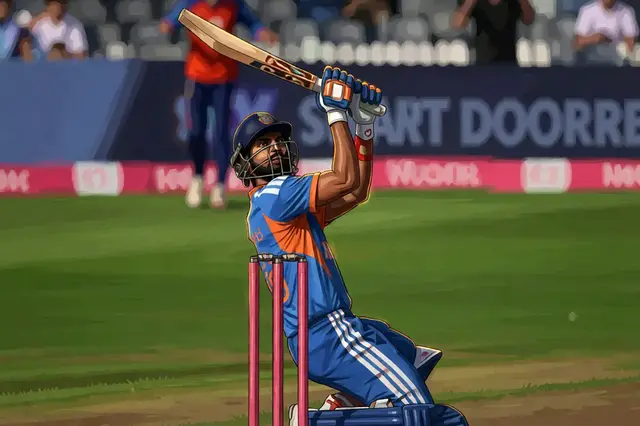
Fifty-five metres, give or take a coat of paint. That is the straight boundary at Eden Park, and on Tuesday night it turned good bowling into a maths problem. Lockie Ferguson's 14th over — hard length, 146 clicks, into the pitch — went 6, 4, 4. At the Wankhede those three balls are dots or a single to long-on. Here they were fourteen runs and a change of plan.
Four days later the same square hosts an ODI. The line from both camps is already out: the conditions will be different. They will be. Just not the way the commentary box means it.
The T20I Was a Different Sport, Not a Different Pitch
The white Kookaburra hoops for four overs and then goes soft. Two new balls, one from each end. A sweeper on the rope from the 11th over. Eden Park's drop-in strip barely changes between formats — what changes is how much protection the fielding side is allowed to give that short straight boundary. In a T20 you cannot. In a 50-over game you can, and that one permission rewires the whole innings.
| Phase | Eden Park ODI RPO (last 9) | Tuesday's T20I RPO | Boundary % | Dot % |
|---|---|---|---|---|
| Powerplay (1-10) | 5.8 | 10.4 | 16.2 | 53.1 |
| Middle (11-40 / 7-15) | 5.1 | 9.6 | 8.9 | 58.4 |
| Death (41-50 / 16-20) | 9.3 | 11.8 | 22.7 | 31.6 |
Look at that middle column. Between overs 11 and 40 this ground produces 5.1 an over, a boundary every eleventh ball, and dots on nearly 58% of deliveries. That is the quiet, unposted part of Eden Park — the stretch where wickets fall to half-trackers, not jaffas. Tuesday's T20I never had that luxury.
Hard Length Is a Trap on This Square
Every dressing room in world cricket now chants 'hard length' like a mantra. Here it is a coin flip. The red soil gives carry — carry to a 55-metre rope. Hitting the deck at 138-plus works when the ball climbs above the batsman's hands and finds the top edge to fine leg. It is a disaster when it is a fraction short, because a flat-batted pull clears this ground without a fielder moving.
Watch Arshdeep Singh's cutters in the first ten. Bowled into the pitch at 128 kph, the ball sits up and invites Daryl Mitchell onto the back foot. Fuller, letting it skid under the swing, and Mitchell's boundary-percentage in the middle overs drops off a cliff — his strike rate against full, straight balls this year sits near 108, against anything short it is 170-plus. That is the matchup. Not 'bounce'.
Spin Won't Choke Here, and That's the Selection Problem
Spin at Eden Park in ODIs since 2023 has leaked 5.9 an over — roughly 0.8 more than the same attacks manage in Christchurch or Hamilton. Kuldeep Yadav's wrong'un does not turn on red soil; it skids, and skid on a small ground means the slog-sweep is on from ball one. Axar Patel's pace into the surface is the better bet. He just does not bowl the 35th over.
Which is why the third spinner is a live debate and not a settled slot. There is no Impact Player crutch in a 50-over game, and a sticky red-soil track under lights punishes anyone who cannot bowl a fourth-over cutter on demand.
Dew, Light Towers and the Second-Innings Tax
Say 'dew factor after 8:30 PM IST' in a studio and everyone nods. Do the arithmetic. The lights at Eden Park come on around 7 PM local, which is 12:30 in the afternoon in Jaipur — our desk is on its second coffee, not its first beer. The dew question in Auckland is a second-innings question, arriving late, changing the ball more than the pitch. Chasing sides have won about 63% of day-night ODIs here since 2019, and the second-innings run rate climbs by nearly a run an over after the 35th.
So: bat first, post 290, trust the hard length under lights? Or chase with the dew and the short boundary in your pocket? Both captains will say the toss does not matter. Neither will mean it.
What the World Cup Audition Actually Tests
Both camps call this World Cup prep. Fine. But the questions this series can genuinely answer are narrower:
- Can India's third seamer — a man who has done the Ranji grind — hold a hard length with no sweeper protecting him?
- Does New Zealand's middle order have a boundary-percentage answer to wrist spin on a skiddy surface?
- Who bowls the 47th over when the yorker is simply not available?
“The pitch does not change between formats. The field does.” — the line doing the rounds in the New Zealand camp this week, and the only cliché here worth keeping.
Half the audience on Tuesday was not really watching cricket. If you were one of the thousands refreshing an rs9 apk download india scorecard page between overs, you saw a 213 chase and assumed this ground always behaves like a video game. It does not. It behaves like a small ground with a big field restriction — and the side that reads that split correctly wins on Saturday. Or Sunday morning, if you are in Jaipur.
Related coverage
- RCB vs GT IPL 2026 Final: Streaming Lag and Rs9 Apk Download India Guide
- New Zealand spin swap, India rest Axar: Dead rubber stats tell all

Updated 2026-11-04 · Instant Rupee Deposits & 60s Withdrawals · 24/7 Support.
Access Official ResumeHelp Portal →Head of Telemetry & Records · Jaipur Desk
Neha Desai heads the statistical modeling desk at ResumeHelp in Jaipur. She specializes in ball-by-ball telemetry, historical chart patterns, and data verification for rs9 apk download india.
Reader Discussion & Match Reactions (4)4.8★ Community (4 Comments)
Verified Indian cricket reader perspectives & tactical debate on resumeshelpservice.com
The data from Eden Park is stark – in the T20I Ferguson’s 14th over yielded 6‑4‑4, turning a potential 14‑run over into a 14‑run spell, while the ODI middle‑phase RPO stalls at 5.1 with only 10.4 % of balls reaching the boundary and a whopping 58 % dot‑ball rate.
The article glosses over the selection nightmare – forcing India to field a second‑spin option just because Eden Park’s 55‑metre straight wall inflates boundary percentages ignores the fact that our top order’s strike‑rates have dipped below 80 in the last three ODIs, a risk the BCCI can’t afford if they keep tinkering with the power‑play field placements.
Those “half‑trackers” the piece mentions are exactly the kind of seamers the Gujarat Ranji squad has been nurturing; Shubham Patel’s 2/21 on a damp Eden Park strip shows how state‑level bowlers can exploit the 58 % dot‑ball stretch, a talent pool the national selectors must tap.
@Saurabh_NRR you nailed the middle‑phase stats, but note the article also flags the death overs at Eden Park – the last ten balls average an RPO of 5.8 with a 31.6 % dot‑ball rate, meaning wickets tumble while runs still flow, a double‑edged sword for any chase.